
Trump's method are more destabilising than his policy. So, a good idea these couple of years is to sip Kool-Aid, and savour the joys of Trumplomacy, asserts Shekhar Gupta.

'The background for the Saudi-Pakistan agreement is the fact that the regional security order has collapsed due to the Israeli attack on Doha.' 'The Americans have largely abandoned their security guarantee for West Asia and the region has no choice but to look at alternatives.'
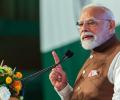
Prime Minister Narendra Modi on Friday said it is important for India and China to work together to bring stability to the world economic order as he asserted that New Delhi is ready to advance bilateral ties from a strategic and long-term perspective based on mutual respect, mutual interest and mutual sensitivity.

United States Charge d'Affaires Natalie Baker on Wednesday met Deputy Prime Minister and Foreign Minister Ishaq Dar as part of efforts to de-escalate tensions with India following the Pahalgam terror attack on April 22 in which 26 people were killed.

Prime Minister Narendra Modi conveyed to Ukrainian President Volodymyr Zelenskyy that India remains committed to making every possible contribution for an early and peaceful solution to the conflict. Zelenskyy sought India's support in limiting Russian energy exports.
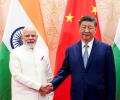
'What's currently underway is not a 'reset'.' 'What needs to be arrived at is a new balance.'
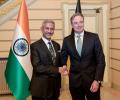
The era where nations thrived through rigid alignments is giving way to an age where the connective State defines power. For India, that era has arrived, points out Dr Nishakant Ojha.
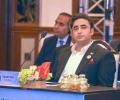
Bhutto, who served as the Foreign Minister earlier, addressed a briefing at the UN Headquarters in New York and sought reconciliation with India, making a plea for talks and Intel sharing between the two neighbours.

India hoped that the agreement will lead to a safe and sustained supply of humanitarian assistance to the people of Gaza.
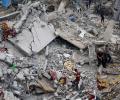
"Intermittent pauses in hostilities are not enough to address the scale of humanitarian challenges confronting the people, who grapple daily with acute shortages of food and fuel, inadequate medical services and lack of access to education," Harish said at the open debate on the 'Situation in the Middle East, including the Palestinian question'.

India on Saturday said it was deeply concerned over the 'evolving escalation' in West Asia and urged all sides to exercise restraint and return to the path of dialogue and diplomacy.
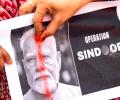
World leaders, including the UN Secretary-General and US President Donald Trump, have urged India and Pakistan to exercise restraint and seek peaceful solutions to the ongoing tensions. The calls for calm come after India conducted airstrikes in Pakistan-occupied Kashmir in response to a recent terrorist attack. Leaders from the US, Russia, UK, China, UAE, Qatar, and Japan have expressed concern over the escalating situation and emphasized the need for dialogue and de-escalation.

The post further read that "at a moment of heightened regional turbulence", President Trump "demonstrated great strategic foresight and stellar statesmanship through robust diplomatic engagement with both Islamabad and New Delhi," Dawn reported.

The leaders said they stand for adherence to international law, peaceful resolution of disputes and respect for principles of the UN Charter, including territorial integrity and sovereignty of all states.

Australian Deputy PM Marles to watch India-Australia World Cup cricket final in Ahmedabad

"It is still not too late. India must speak clearly, act responsibly, and use every diplomatic channel available to defuse tensions and promote a return to dialogue in West Asia," Gandhi asserted.

India has been in touch with all parties concerned as part of overall global efforts to bring down the tensions.
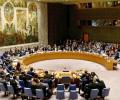
The United Nations Security Council held closed-door consultations on rising tensions between India and Pakistan, with envoys calling for restraint and dialogue. The consultations, requested by Pakistan, lasted for about an hour and a half. UN Secretary-General Antonio Guterres expressed concern over the tensions, urging both countries to avoid a military confrontation. India's former Permanent Representative to the UN, Syed Akbaruddin, said that no consequential outcome could be expected from the discussion.
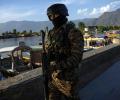
The 'mediation' by the United States from behind the scene on the diplomatic track appears to be once again working, which calls on both Delhi and Islamabad to show restraint and pull back from a military confrontation, notes Ambassador M K Bhadrakumar.

'Still, people are asking why we have not gone for a full-out war. As a military man, if ordered, I will go to war, but that will not be my first choice'
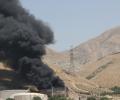
Asked about the expectations from the US, Azar said Washington and Israel are "completely in sync". He said he felt that the US would "support" Israel's action.

One Iranian woman, who is the wife of an Indian national has also been evacuated, he added.
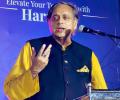
Tharoor had earlier criticised India's stance when Russia attacked Ukraine and called for condemnation of the aggression.
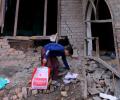
Amid escalating tensions between India and Pakistan, the US has said it will not get involved in the conflict, stressing that it is "fundamentally none of our business." While acknowledging concerns about a potential nuclear war, Vice President J D Vance emphasized that the US cannot control India and Pakistan, but can encourage them to de-escalate. The US has also reiterated its support for direct dialogue between the two countries and encouraged efforts to improve communications.
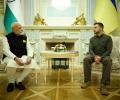
Ukraine and Russia need to engage with each other to find a solution to the ongoing conflict between them, India said on Friday after Prime Minister Narendra Modi held wide-ranging talks with President Volodymyr Zelenskyy in Kyiv under the shadow of the raging war.
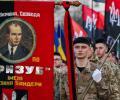
'We will never recognise any part of territories occupied by the Russians.'

Jaishankar said the world has experienced its consequences in terms of higher costs and shortages of foodgrains and fertilizers and fuel.
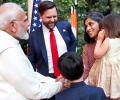
Prime Minister Narendra Modi and US Vice President JD Vance have expressed satisfaction with the progress made in negotiations for a bilateral trade agreement. The two leaders met in New Delhi and discussed a range of bilateral issues, including cooperation in energy, defense, strategic technologies, and other areas. They also exchanged views on regional and global issues of mutual interest.

Prime Minister Narendra Modi on Tuesday conveyed to Russian President Vladimir Putin that India stands ready to provide all possible cooperation towards ending the Russia-Ukraine conflict and that dialogue and diplomacy is the only way to bring peace to the region.
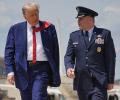
He then went on to say that, however, he won't get a Nobel Peace Prize for any of his efforts.
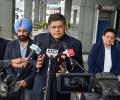
'It is high time that the 'war on terror' is removed from our diplomatic toolbox.' 'Certainly, our parliamentarians have no role in it,' asserts Ambassador M K Bhadrakumar.

Though he does not know what New Delhi is intending to do, Berlin would "welcome any engagement", he added.
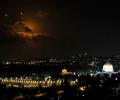
India also advised its citizens to avoid all non-essential travel to Iran.

India and China on Monday decided to resume the Kailash Mansarovar Yatra as the two sides agreed to take certain people-centric steps to 'stabilise and rebuild' ties.
Prime Minister Narendra Modi has held talks with Ukrainian President Volodymyr Zelenskyy and reiterated India's commitment for an early resolution of the conflict in Ukraine and the restoration of peace and stability in the region.
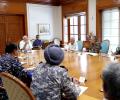
'One good outcome of Operation Sindoor -- perhaps, its best outcome -- could be that India has resumed meaningful contact directly with Pakistan at the military-to-military level,' observes Ambassador M K Bhadrakumar.
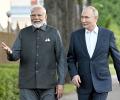
Ahead of Modi-Putin talks, the US called upon India to make it clear to Russia that any resolution of the Ukraine conflict must respect the United Nations charter and Ukraine's territorial integrity and sovereignty.
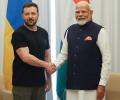
Prime Minister Narendra Modi on Friday conveyed to Ukrainian President Volodymyr Zelenskyy during a meeting that India would continue to do everything within its means to support a peaceful solution to the Ukraine conflict and that the way to peace is through 'dialogue and diplomacy'.

'There is no question that Putin's preference will be to avoid unpleasantness with Trump, leave alone a collision course,' observes Ambassador M K Bhadrakumar.

Modi in a post on X said the two leaders also discussed measures to further strengthen Special and Privileged Strategic Partnership between the two countries.
